#35 You’re Doing Too Much; Design as Infrastructure
Marcel McVay approached me after my talk at the DDX conference in San Diego, September 2025. What was meant just to be a polite exchange turned into one of the most interesting discussions about design and designers I’ve ever had. Marcel surprised me by pointing out what he thought was the essence of my short presentation, which I thought had gone way over the heads of the audience. Not because my talk was so clever, but because I thought that my observations were far too specific – too European, too Old-White-Man, too philosphical. No mention of AI, no fast-moving videos, just a few thoughts. It felt good that I had not totally wasted my time, nor obviously Marcel’s.
Below is what he made of my presentation. I did have the catchy title of Five Lessons Learned After Fifty Years, but as you’ll see, I threw in one more – so now there’s half a dozen.
***
Marcel publishes a very cool blog/website/homepage called Signal+Static: all white monospaced type on black with cryptic illustrations. See for yourselves: signalstatic.net
Thank you, Marcel, for letting me re-publish your re-view.
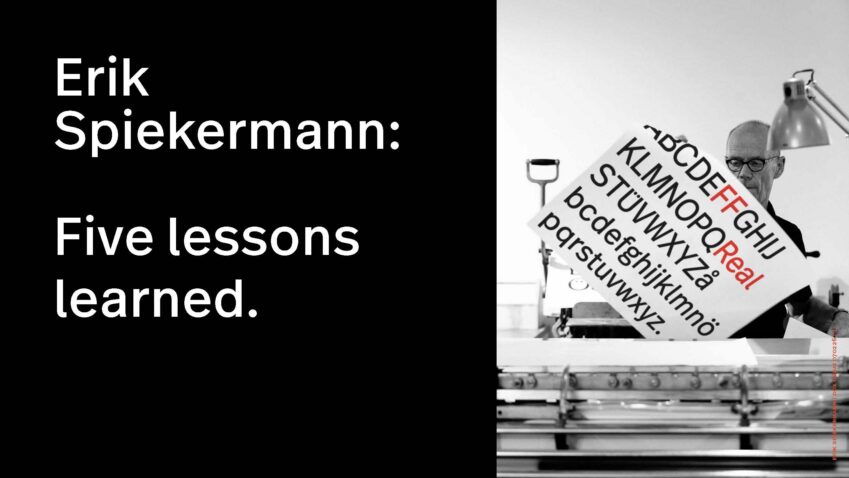
Erik Spiekermann didn’t come to DDX to talk about trends. He came to talk about gravity. The physics of design infrastructure. How do you create and lead work that lasts?
Fifty years of work has a way of grinding the lacquer of hype off a discipline, leaving what was actually load-bearing. What remains is structure, consequence, and a sharp sense of what stands through time. Spiekermann’s talk, framed as “lessons learned,” was less a retrospective than a reminder: design is not an aesthetic layer. It is human infrastructure.
There’s something you should know about Erik. He’s blunt, he’s to the point. His voice cuts to the bone because it has spent decades inside the system. When I told him I liked his attitude, he replied simply, “What attitude? I’m German.” It mirrors how he designs, and how he runs his firm. So let’s get to it — Erik’s Five Lessons from Fifty Years in the biz.
Attitude as Infrastructure
The first lesson was about attitude. Treat people well. Credit them. Do not pretend you are self-sufficient.
Over decades, students become clients, clients become collaborators, collaborators become teachers. Reputation always compounds, whether that is accolade or abuse. You don’t get to opt-out of the math.
This was framed as the ethics of systems thinking. Like a virus, if you poison the network, the signal degrades everywhere.
Compatibility
When a client calls and the room goes quiet, something is broken. Internal eye rolls are not personality problems. They are a symptom of systemic misalignment.
Spiekermann was direct about the cost of working with people you know will be wrong for you or your team. Greed and necessity tempt us into bad alignments, and as designers we’re great at rationalizing both. But those projects rarely pay in money or meaning.
Design leadership needs the discipline to say no early and comfortably, despite an apparent loss in revenue. The cost will, inevitably, be more than the pay.
Branding Is Simpler Than You Think
Erik stripped mystique off branding. Branding, he argued, is simple because humans are simple. Complexity in branding more often signals insecurity than sophistication.
We recognize color, rhythm, and repetition long before we parse messaging. Berlin is yellow. London buses are red.
Deutsche Bahn is white, black, and red, recognizable even without a logo. One clear idea, consistently applied, can outlive teams, governments, and technologies. Complexity lives in execution, not in the core concept.
Typography as Nervous System
Typography — constantly misunderstood as an ornament, as something to apply “after” — Erik frames as nervous system.
Type works when people don’t notice it consciously. Its success is felt, not declared. Spiekermann described the pleasure of anonymity here: drinking from a cup printed in a typeface he designed, uncredited, yet instantly legible to those who know. That invisibility was the point. Infrastructure works best when it disappears into use.
Work Is a Gas
That Erik works so quickly is not superhuman talent. It’s a technique fueled by sharp and deliberate intent.
Many of his examples were two-hour projects, executed immediately. He demonstrated, through a rapid slideshow of 20-minute projects, that ideas will take as long as the permission you give them.
Constraints sharpen judgment. Pressure clarifies decisions. Work, he reminded the room, behaves like a gas. It expands to fill the time you give it.
This was not an argument for burnout, but for intentional pacing. Artificial urgency can sometimes produce a truer focus than an endless runway.
Teams and The Rule of Seven
More people do not equal faster outcomes. Beyond a team of seven, coordination costs balloon. Communication splinters and responsibility blurs. Design, at scale, is as much about metabolic regulation as output.
What made the talk land was how little it relied on nostalgia. There was no lament for a lost golden age of print, no anxiety about AI tools. Spiekermann’s lessons translate cleanly into the post-AI landscape because they were never tool-dependent to begin with. They have always been about human systems under pressure. (Regular readers will read that as cyborg systems.)
In a conference, and era, filled with agents and automation, his talk grounded the room. Design survives acceleration when it is treated as infrastructure. Social, cognitive, and cultural — it’s the stuff you only notice when it fails.
If you want to design for the future, build things that can be trusted to disappear. ★